


General Discussion
From ornamental gardens to unique floral arrangements, flowers possess a timeless elegance and are the... View more
Organizer:
- Organized by
-
-

Why Does My Motorcycle’s Headlight Flicker at Idle but Stabilize When Revving
-
Why Does My Motorcycle’s Headlight Flicker at Idle but Stabilize When Revving
Sitting at a red light at night and watching your motorcycle’s headlight pulse or dim rhythmically with the thrum of the engine is a common experience for riders. The moment you roll on the throttle and the engine RPM rises, the beam instantly brightens and stabilizes into a steady, solid beam of light. While a minor flicker might seem like a harmless quirk of motorcycle ownership, it is often an early warning signal from your vehicle’s electrical infrastructure. Unlike modern automobiles that utilize heavy-duty belt-driven alternators capable of delivering robust current across all engine speeds, motorcycles employ compact, specialized charging networks that operate under tight mechanical and thermal limits. Understanding the physical and electrical relationship between engine rotation, magnetic induction, and current delivery is essential to determining whether your flickering light is normal behavior or the precursor to a stalled bike.
Understanding Stator Output Dynamics and Engine RPM Dependencies
At the heart of every motorcycle’s electrical system lies the stator assembly, a series of copper wire coils mounted inside the engine case paired with a flywheel containing permanent magnets. As the crankshaft turns, the flywheel spins around the stator, inducing alternating current (AC) electricity through electromagnetic induction. The crucial factor to realize is that a stator’s voltage output is directly proportional to engine speed. At a standard engine idle—typically between 1,000 and 1,400 RPM—the permanent magnets pass across the copper coils at a relatively slow velocity, generating minimal electrical output. As you twist the throttle and increase engine revs to 3,000 RPM or higher, the rapid rotation dramatically boosts the generated voltage. If your total electrical draw at idle equals or exceeds the raw output produced by the stator, the system experiences a momentary voltage drop, causing the headlight to visibly dim or pulse until higher engine speeds restore peak generation.
Evaluating Battery Buffer Health and Resistance Under Load
While the stator generates power during operation, the motorcycle battery serves as a critical voltage stabilizer and electrical buffer for the entire machine. When the engine drops to idle speed and stator output dips below the threshold required to power the ignition, fuel pump, instrument cluster, and lighting, the battery is supposed to step in and seamlessly bridge the power deficit. However, as batteries age, they experience chemical degradation, sulfation on lead plates, and increased internal electrical resistance. A weak or dying battery loses its ability to hold a strong resting voltage and absorb fast system fluctuations. Instead of buffering the low voltage during low-RPM idle, a compromised battery allows electrical sag to impact consumer components directly. Consequently, a flickering headlight at idle is frequently the very first sign of a deteriorating battery long before the engine fails to crank.
Checking the Regulator/Rectifier and System Wiring Corrosion
Between the raw AC output generated by the stator and the sensitive DC components powering your motorcycle sits the regulator/rectifier (R/R). This crucial component converts variable AC voltage into stable DC voltage while continuously venting excess energy as heat to prevent overcharging. If the diodes or internal circuitry within the regulator/rectifier begin to break down from thermal stress, the unit may fail to regulate voltage cleanly at lower input levels. Furthermore, electrical wiring connections throughout the motorcycle chassis accumulate oxidation, road grime, and moisture over time. Corrosion on spade terminals, grounding lugs attached to the frame, or inside the handlebar switch housing introduces high electrical resistance. This added resistance drops supply voltage further before it reaches the headlight bulb filament, amplifying visible light flicker during low-power idle periods.
Mastering Diagnostic Workflows and Electrical Maintenance
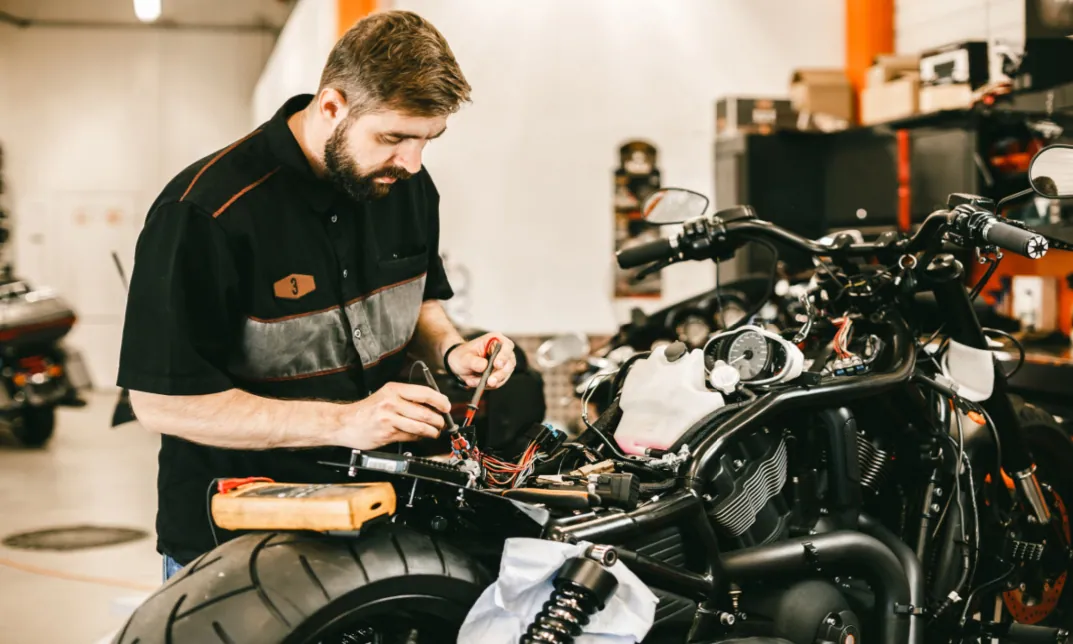
Pinpointing the exact cause of an electrical anomaly requires a structured troubleshooting routine rather than blindly swapping out expensive components. Technicians use digital multimeters to measure static battery voltage, charging voltage across various RPM bands, and stator coil resistance. Gaining the technical confidence and practical skill set needed to diagnose complex motorcycle electrical networks, service charging systems, and maintain peak mechanical reliability is a primary objective taught in a dedicated motorbike maintenance course. Learning how to interpret voltage drop tests, perform parasitic draw evaluations, and read intricate wiring diagrams allows riders and aspiring mechanics to solve underlying electrical issues efficiently, ensuring that lighting systems remain bright, stable, and completely safe during night rides.
Comparing Lighting Technologies and Implementing Preventive Care
The specific lighting technology installed on your motorcycle also dictates how sensitive your headlight is to voltage variations. Traditional halogen bulbs utilize a tungsten filament that reacts slowly to minor power drops, resulting in a smooth, warm dimming effect at idle. Conversely, aftermarket LED conversions draw significantly less current overall, but cheap or un-regulated LED drivers can be hyper-sensitive to unclean DC ripple current, causing sharp, rapid strobing effects when voltage dips at idle. To maintain clean power delivery across all lighting types, riders should regularly inspect and clean battery terminal posts, apply dielectric grease to exposed wiring harness connectors, and ensure ground connections remain tightly torqued to the chassis. Taking proactive care of your motorcycle’s electrical network prevents unexpected roadside breakdowns and ensures optimal night-time visibility on every journey.
wisecampus.org.uk
Motorcycle Mechanic Course online Training with Free Certificate
Join our Motorcycle Mechanic Course Online with a free PDF Certificate. Learn pro bike repair skills online & boost your career.
Sorry, there were no replies found.